105th ENGINEER COMBAT BATTALION |
|
|
105th ENGINEER COMBAT BATTALION |
|
|
 |
Home | 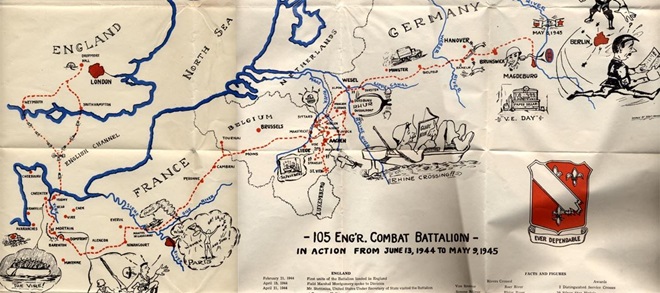 |
|
About the 105th | |
|
Getting Started | |
|
Photo Gallery | |
|
Useful Links | |
|
History | |
|
Calendar of Events |
The first elements of the US Army 30th Infantry Division landed at Omaha Beach, Normandy, France on 10 June 1944. With them came their Divisional Engineers, the 105th Engineer Combat Battalion. Combat Engineer duties included: laying and clearing mine fields, establishing bridgeheads, destroying enemy bunkers and other obstacles, repairing roads and fighting as infantry when needed. Anything to speed up the Allied armies and slow down the Germans as the Allies advanced across Europe.
The 30th Division, supported by the 105th ECB, was involved in some of the most important battles in the European Theater of Operations (ETO). It entered combat on 15 June near Montmartin-en-Graignes and liberated Airel on 6 July. They crossed the Vire River at Saint Fromond and secured the Vire Et Taute Canal on 7 July. Here the 105th ECB earned the Distinguished Unit Citation for constructing a footbridge across the Vire under heavy enemy artillery fire, repairing the bridge multiple times while suffering twenty casualties during construction. On 25 July 1944 the 30th Division spearheaded the breakout from Normandy in Operation Cobra and the drive to Saint Lo. At the Battle Of Mortain 7-12 August they held off fierce enemy attacks while heavily outnumbered and halted Operation Lüttich, the Germans attempt to drive to the sea at Avranches and split the American forces. The 30th further distinguished itself as it moved on into Belgium and Holland, crossing the Meuse River at Liege on 10 September, liberating Visé on 12 September and Maastricht on 14 September. At the Battle Of Aachen 2-21 October the Division entered Germany, crossed the Wurm River near Scherpenseel, breached the Sigfried Line and helped close the circle to force a surrender and occupation of the first major German city of the war.
Following more heavy fighting in the Alsdorf sector, and holding against two well organized German counterattacks, Mariadorf was taken on 17 November, Kinzweiler and St. Joris on 19 November. After this the Division was constitutued Corps Reserve and fell back to Mariadorf for rest, reorganization, re-supply and training. In response to the German Ardennes Offensive (also known as the Battle Of The Bulge), the 30th was rushed to the Malmedy-Stavelot area on 17 December 1944. The 117th Infantry Regiment and 105th ECB held at Stavelot with the 105th destroying the bridge over the Ambleve River, cutting off the main column of Kampfgruppe Peiper from it's rearguard refuelling and supply units. After clearing the sector north of the Ambleve River between Stavelot and Trois Ponts, the Division launched a counteroffensive towards Malmedy, Stoumont and La Gleize with great success. They continued their advance south and supported the 7th Armored Division in re-taking St.Vith on 23 January 1945.
Halting only to regroup in preparation for the Roer River offensive, the 30th Division assaulted across the Roer near Julich on 23 February 1945. Again with support from the engineers the 30th crossed the Rhine River with three regiments abreast on 24 March. Fighting through heavily wooded terrain the Division took Braunschweig on 12 April, crossed the Elbe River and helped reduce Magdeburg on 17 April. The Division made contact with the Soviet Red Army at Grunewald on the Elbe River on 5 May and continued occupation duties until the end of hostilities was declared on 8 May. The 30th then began moving for home, arriving back in the United States on 19 August. With the Japanese surrender on 2 September the division was subsequently inactivated at Fort Jackson, South Carolina on 25 November 1945.
This page shows how the Army was structured during WWII as well as the chain of command and rank insignia.
Various statistics about WWII soldiers, production, and losses.


